
A US Congressman has introduced a resolution urging the US government to recognise the 1971 atrocities committed against Bengali Hindus in Bangladesh by the Pakistani Army as a genocide, seeking justice and historical acknowledgement.

Russia and China vetoed a Bahrain-backed UN resolution aimed at reopening the Strait of Hormuz. A resolution that was already diluted to secure their abstentions.

US President Donald Trump said on Wednesday that Washington is considering a "joint venture" with Iran to secure the Strait of Hormuz, following his announcement of a two-week ceasefire.

Pakistan's security forces claim to have killed hundreds of Afghan Taliban operatives in an ongoing military operation along the border, launched in response to attacks on Pakistani locations.

'Neither do the Israelis. The two attacking parties have very little economic interest in Hormuz.'

The core issues to be settled -- access to Hormuz, Israel's aggression in Lebanon, the question of Iran's nuclear programme, sanctions relief and compensation -- are thorny enough to require weeks of patient negotiation. The most likely outcome of the opening sessions is that both sides take the measure of each other, establish what is and is not negotiable, and return home without having broken anything. That would count as progress.
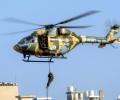
'The tools of warfare are changing. The MoD must deepen its engagement with technology thinkers that can present compelling visions of where warfare may be heading.'

Both sides have now revealed a preference for escalation over strategic defeat, and each new provocation narrows the space for the next pause. The Touska seizure, Iran's refusal to negotiate under blockade, Israel's strikes on Iranian oil infrastructure -- all of these add up to an increasingly untenable situation. This makes the wild card -- Trump and his motormouth -- more consequential than ever, notes Prem Panicker in his must read blog on the Iran War.
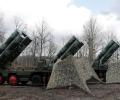
The Indian Defence Ministry has approved the procurement of weapons and military hardware worth Rs 2.38 crore, including S-400 missiles and medium transport aircraft, to bolster the Indian Air Force's capabilities.

Trump may strike. He may announce productive talks and extend again. He may do both at the same time. Iran will not open the Strait on someone else's terms, so no matter what happens, that problem will remain unsolved. And the IRGC will still be collecting its $2 million toll from every ship bold enough to ask permission to pass.

Afghanistan's anti-doping programme has collapsed since the Taliban's return to power, with no tests conducted for three years and the country's exiled anti-doping chief admitting there is currently 'no hope'. The programme faces numerous challenges, including a lack of Doping Control Officers, logistical issues, and political instability.
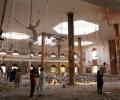
Pakistan has backed China's claim that Beijing played a role in defusing tension with India during Operation Sindoor, calling it 'diplomacy for peace' that was part of international efforts.

India and Pakistan exchanged lists of nuclear installations and prisoners, continuing a long-standing practice despite strained relations.

The question is whether the clocks allow enough time for two deeply mistrustful sides to get there, and whether the surface calm holds long enough for the paddling to produce something before the ceasefire ends on April 22, notes Prem Panicker in his must read blog on the Iran War.
Pakistan launched a retaliatory operation, 'Ghazab lil Haq,' against the Afghan Taliban following alleged border attacks, resulting in reported casualties and destruction of Taliban infrastructure.
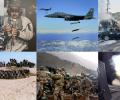
Since 1945, the United States has carried out aerial bombing operations in an alarming number of countries.

Russia has expressed strong concern over a US-Israeli strike on the Iranian port of Bandar Anzali, a key transit hub on the INSTC, warning of the risk of drawing Caspian states into the ongoing conflict.
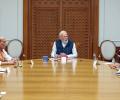
Prime Minister Narendra Modi will chair a meeting of the Cabinet Committee of Security (CCS) in Delhi to discuss the global situation following the attack on Iran and the killing of Iranian Supreme Leader Ayatollah Ali Khamenei.
'Surgical strikes or air strikes, or both, are likely on the table.'

The United States, which entered this war in expectation of a short, sharp win along the Venezuela model, is now preparing for deeper involvement in a conflict it does not fully control, without the allies it typically relies on, against an adversary that is not behaving as expected, in a global environment that is already absorbing economic shock. Prem Panicker continues his must read daily blog on the Gulf War.

Two senior players of the Sri Lankan cricket team, including skipper CharithAsalanka, currently touring Pakistan for a T20 tri-series will be returning home due to illness, Sri Lanka Cricket (SLC) said on Monday.

This election is different. It is no longer simply about governance or welfare. It is about identity, fear, and who belongs. The BJP has successfully shifted the terms of the debate from what the government has delivered to who the real Bengali is and who is an outsider, points out Ramesh Menon.

The ceasefire is still technically holding, to the extent that no overt hostilities have been reported yet, but the rhetoric has hardened dangerously. The week ahead will also clarify whether the Islamabad failure was a negotiating tactic or whether Washington has genuinely locked itself into a position from which the only exits are climb-down, escalation, or the slow bleed of a new status quo that nobody chose and nobody controls. Prem Panicker continues his must read blog on the Iran War.

'In such a scenario, Iran could proclaim itself victor, rebuild, re-enforce its diminished regional proxies to further destabilise neighbouring nations and take control of the Persian Gulf and Strait of Hormuz.'
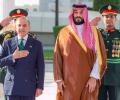
Prime Minister Shehbaz Sharif met with Saudi Crown Prince Mohammed bin Salman to express Pakistan's support for the Kingdom amidst escalating tensions in West Asia, reaffirming their mutual defence pact and commitment to regional stability.

'The next two to three weeks will not be decided in Washington.' 'They will be decided in Tehran, in whatever calculation Iran makes about the costs of continued resistance against the costs of appearing to have yielded.'

The cost of the war is being counted not in the corridors of power in Washington or Tehran, but in Firozabad's darkened furnace rooms, Howrah's idle casting sheds, and a barbershop in Kochi where the wait is suddenly, inexplicably, an hour long, notes Prem Panicker in his must read blog on the Iran War.

Jazz City could have been enjoyable had it not been so densely over-plotted and unevenly executed, notes Deepa Gahlot.

India strongly condemns Pakistan's airstrikes in Afghanistan, decrying the civilian casualties and reaffirming its support for Afghan sovereignty amidst rising tensions.
The pause gives the US time to breathe, to regroup, to move its expeditionary force into position without risk of interception along the way. It gives Iran nothing -- on the ground, attacks against its infrastructure continue apace. Prem Panicker in his must read daily blog on the Gulf War.

India's handling of the Iran crisis reflects a growing strain between strategic autonomy and geopolitical alignment, observes Ambassador M K Bhadrakumar.

Newly declassified documents from the United States National Security Archive have revealed that Pakistan's nuclear proliferation was a significant concern for both the US and Russia, with leaders expressing 'nervous' fears about the country's atomic stability.

The question is no longer whether the war will expand. It has. The next few days will tell us whether the war stabilises around Hormuz or whether the Strait itself becomes the trigger for a far larger rupture. What to watch for over the next 48 hours is simple: Any move by the US toward direct naval control of the Strait; any credible Iranian attempt to disrupt or mine shipping lanes and, critically, whether energy infrastructure in the Gulf continues to be targeted.If those lines are crossed in tandem, the war will no longer be containable within the region.

A US federal government commission has raised concerns about the state of religious freedom in India, recommending its designation as a 'Country of Particular Concern' and suggesting targeted sanctions.

Saudi Arabia and the UAE are actively pushing Trump to take the war to its bitter finish and 'erase' Iran's presence in the geopolitics of the region. Simply put, the two most powerful Sunni Arab oligarchies are on the same page as Israel. Such interference increases the risk of a breakdown in dialogue between the US and Iran, points out Ambassador M K Bhadrakumar.
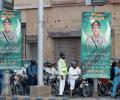
Speculation swirls in Pakistan regarding potential changes in the political landscape, fueled by rumors of the army chief's possible presidential aspirations and discussions between top civilian and military leaders.
Records stretching back to 1947 suggest a consistent strategy by Pakistan's military and intelligence apparatus, the Inter Services Intelligence (ISI), of using terrorism as a state policy against India.

Pakistan has extended its airspace ban for Indian aircraft until January 23, 2026, continuing restrictions imposed after the Pahalgam attack. India has reciprocated with a similar ban.

This weekend, Donald Trump has begun to say the quiet part out loud -- that he wants to take control of Iran's oil, a formulation more in line with his robber-baron style of international relations.
India has decided to submit a dossier at the upcoming Financial Action Task Force (FATF) meeting, calling for Pakistan to be placed back on the grey list of the global money laundering and terrorist financing watchdog.
 © 2026 Rediff.com - Advertise with us - Disclaimer - Privacy Policy - Sitemap - Feedback - About us - Terms of use - Grievances